Who Operates NFEC
Institutions responsible for operating and implementing NFEC nationwide, and the phased process that keeps compliance running every year.
NFEC Is Operated Through a Coordinated National Framework
The Nigeria Fire Extinguisher Control (NFEC) programme is a national fire safety and public protection system operated through a partnership between government institutions and a technology provider.
Each organisation has clearly defined roles, ensuring transparency, accountability, nationwide coverage, and sustainability.
- Government-led ownership with policy direction and statutory authority.
- State-level delivery that brings compliance to roads, workplaces, markets, and communities.
- Technology backbone that keeps extinguishers traceable, verifiable, and automatically compliant.
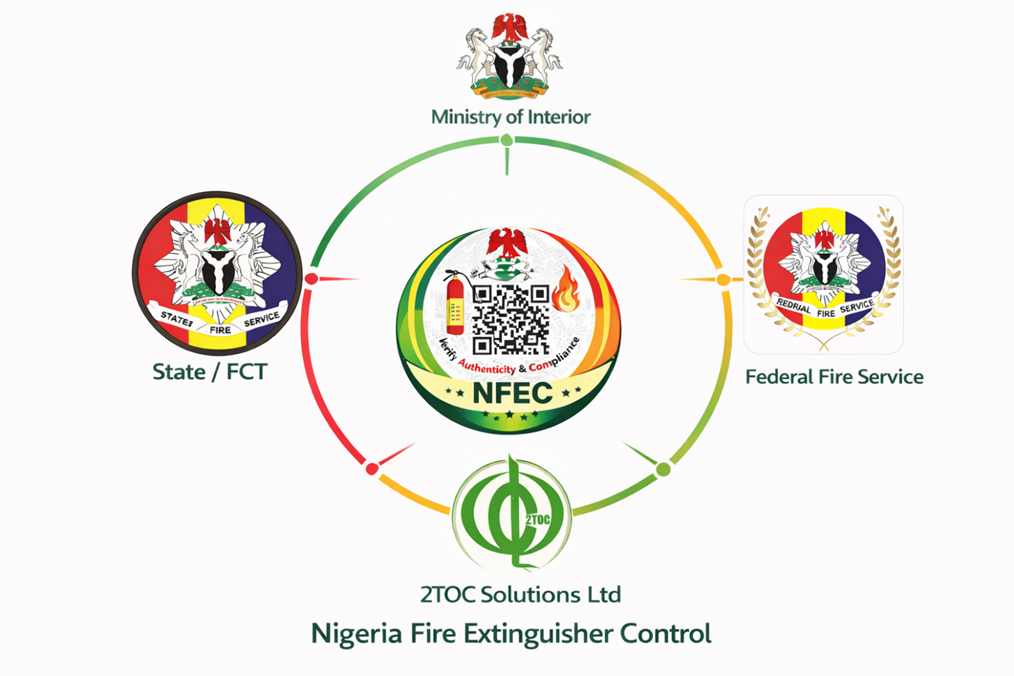
Institutions Responsible for Operating and Implementing NFEC Nationwide
Clear roles for coordination, statutory authority, state-level execution, and technology enablement.
Role: National Coordination Authority
- Coordinates participating Ministries, Departments, and Agencies (MDAs).
- Aligns NFEC with national internal security and public safety policies.
- Ensures cooperation across federal and state institutions.
In simple terms: MOI ensures all government institutions work together under one national fire safety system.
Role: Project Issuing Authority
- Issues and supervises the NFEC programme.
- Coordinates the NFEC Project Delivery Team (PDT).
- Oversees Fire Extinguisher Identity (FEID) compliance nationwide.
- Leads joint enforcement with State Fire Services.
- Registers manufacturers, importers, warehouses, and storage facilities.
- Coordinates national fire safety data through NFDRC.
In simple terms: FFS is responsible for NFEC operations and fire safety compliance nationwide.
Role: State & Community-Level Operators
- Register fire extinguisher servicing vendors.
- Operate Fire Service welfare/cooperatives as FEID distributors.
- Conduct joint enforcement with FFS and FRSC.
- Integrate FEID compliance with vehicle roadworthiness inspections.
- Organise free public fire safety training and community education.
In simple terms: State Fire Services bring NFEC directly to roads, workplaces, markets, and communities.
Role: Technology Concessionaire & Implementation Partner
- Operates the Fire Extinguisher Identity Management System (FEIMS).
- Makes fire extinguishers traceable and verifiable.
- Automates annual FEID compliance with vehicle inspections.
- Coordinates aggregators and distributors.
- Provides training, system support, and ongoing innovation.
- Develops additional NFEC-aligned safety products.
In simple terms: 2TOC provides the technology that connects all NFEC operators.
How NFEC Is Implemented
NFEC Implementation Process (Phases 1–3)
Building the foundation before nationwide rollout.
- Design and development of NFEC systems and processes.
- Testing on designated pilot locations.
- Stakeholder engagement with federal, state, and sectoral institutions.
- Comprehensive rehabilitation of the National Fire Data Repository Centre (NFDRC).
- Development of regulatory tools: UNFDRS and NFERC.
- Composition of the inter-agency Project Delivery Team (PDT).
Outcome: NFEC is tested, approved, and institutionally owned before deployment.
Taking NFEC to states, roads, and communities.
- Commencement of nationwide data capture.
- Establishment of the NFEC Project Delivery Team at FFS Headquarters.
- Stakeholder training for FFS, SFS, and SEMA/FEMA.
- Free public training on extinguisher use and FEID compliance.
- Appointment of Fire Service welfare/cooperatives as FEID distributors.
- State-wide rollout of distributor–IIE alliance operations.
Outcome: NFEC becomes operational, visible, and trusted nationwide.
Making compliance routine, digital, and transparent.
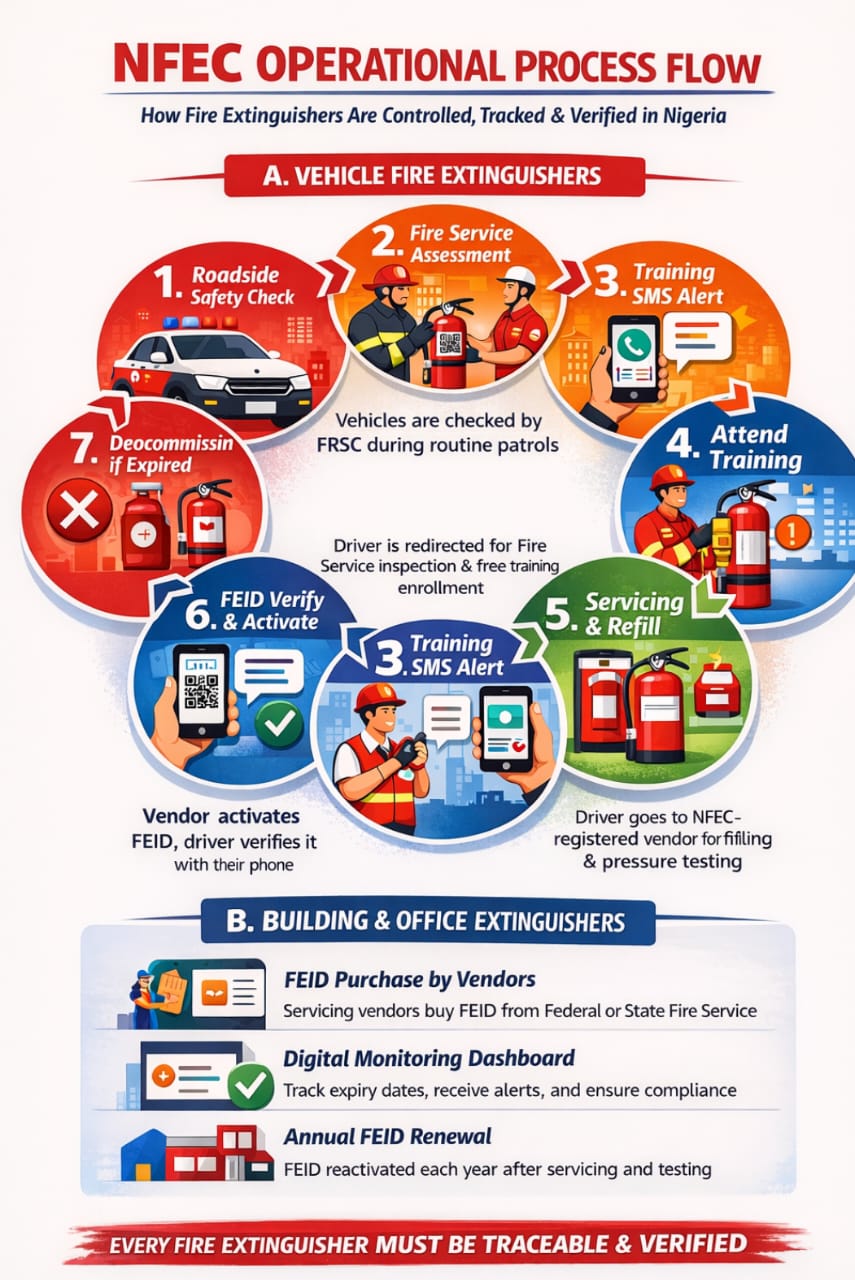
- Alignment of FEID compliance with annual vehicle roadworthiness.
- Automation through 2TOC systems and VIO integration.
- Annual Distributor IIE FEID activation token operations.
- Continuous compliance monitoring, enforcement intelligence, and reporting.
Outcome: Fire extinguisher compliance becomes automatic, auditable, and sustainable.
How Everything Fits Together
- MOI – Policy coordination.
- FFS / NFDRC – Authority and national control.
- State Fire Services – Community-level implementation.
- 2TOC Solutions Ltd – Technology and automation.
In one sentence: NFEC is operated by government fire institutions, coordinated nationally, implemented locally, and powered by technology to protect lives and property across Nigeria.